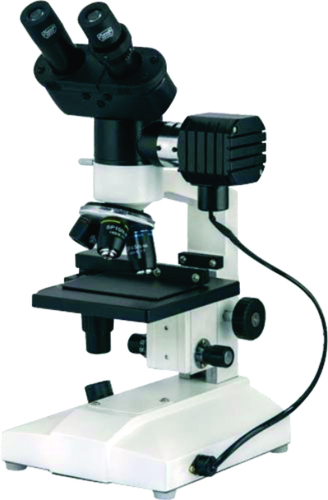
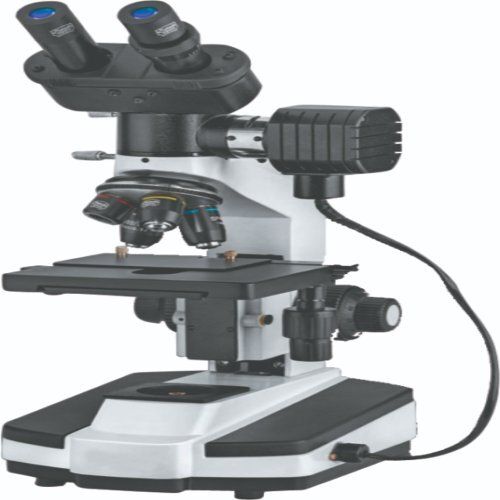
Binocular Metallurgical Microscope Model UMM-15 About
Bodyat45
NosepieceFocusingStage Large Low coaxial Mechanical Stagefor XY movement of specimens up to thickness of 65 mmBright eld vertical illuminator6V20W Halogen with aperture diaphragm lter slots andObjectivesAchromaticM4XM10XM40X
EyepiecesWF10XandH15X
Precision and DurabilityWith its sturdy die-cast metal frame and powder-coated finish, the UMM-15 offers reliability in demanding lab settings. The anti-rust, anti-fungal optics, and smooth mechanical stage empower users to perform meticulous specimen analysis without compromising durability or safety.
Optimized for Metallurgical AnalysisSpecially engineered for metallurgical studies, this microscope excels in visualizing opaque samples under incident and transmitted illumination. The revolving nosepiece with plan achromatic objectives and ergonomic binocular head enable high-resolution, fatigue-free observation, ideal for research, education, and quality control.
User-Centric, Adjustable FeaturesFrom adjustable interpupillary distance (55-75 mm) to a 45-degree inclined, 360-degree rotatable binocular head, the UMM-15 ensures comfort and flexibility. The variable focal length, precise coarse/fine adjustments, and integrated carrying handle make it user-friendly and portable for various laboratory environments.
FAQ's of Binocular Metallurgical Microscope Model UMM-15:
Q: How is the UMM-15 microscope suited for metallurgical analysis?
A: The UMM-15 is designed specifically for metallurgical studies, using reflected (incident) light to examine opaque, unprepared specimens like metals and minerals with high resolution. Its plan achromatic objectives and robust mechanical stage provide large movement range, making it ideal for quality control and research applications.
Q: What are the optical and mechanical features that enhance usage and precision?
A: This microscope includes a quadruple revolving nosepiece with plan achromatic objectives (4X, 10X, 40X SL, 100X SL dry), paired WF10X eyepieces, a precise X-Y mechanical stage with vernier scales, and coaxial coarse and fine focus systems (fine adjustment up to 0.002 mm). These features ensure crisp, detailed visualizations and repeatable positioning.
Q: When should I use incident versus transmitted illumination on the UMM-15?
A: Use incident (reflected) illumination for opaque metallurgical samples such as metals and alloys, which do not allow light to pass through. Switch to transmitted illumination only when working with translucent or transparent samples (if necessary), as most metallurgical applications require reflected light for optimal imaging.
Q: Where can the UMM-15 be effectively utilized?
A: The UMM-15 is widely effective in metallurgical laboratories, educational settings, research institutes, and quality control departments. Its versatile design supports use in hardware industries, academic labs, and facilities focused on the analysis of alloys and minerals.
Q: What is the process for adjusting focus and stage movement?
A: Focusing is achieved using coaxial coarse and fine focus knobs, providing a range of 15 mm (coarse) and 0.002 mm (fine) for precise adjustments. The mechanical stage allows X-Y movement of approximately 70 x 30 mm, controlled by vernier scales for accurate specimen positioning during observation.
Q: How does the anti-fungal treatment benefit the microscope's optics?
A: The anti-fungal coating on all optical components prevents fungal growth, especially in humid environments, ensuring long-term image clarity, reduced maintenance, and extended equipment lifespan.
Q: What are the benefits of the ergonomic and manual interface design?
A: The ergonomically inclined and rotatable binocular head, adjustable interpupillary distance, and integrated carrying handle promote comfortable prolonged use and safe transportation. Manual controls put the user fully in charge, fostering skill development and ensuring reliability without digital interference.






 Send Inquiry


 Send Inquiry