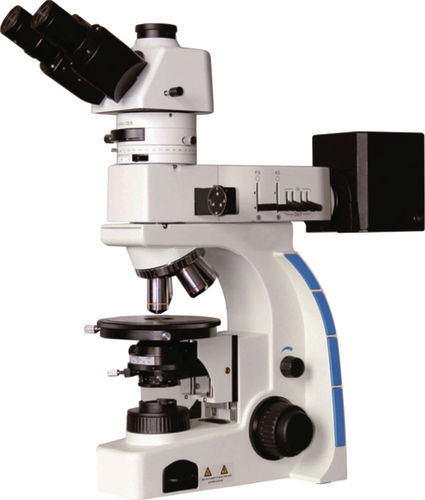
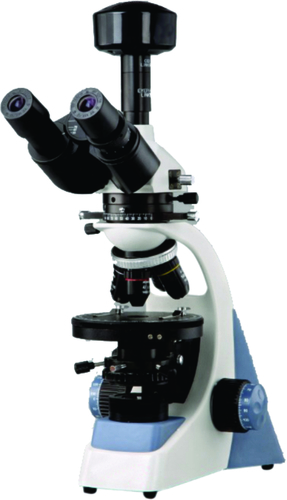
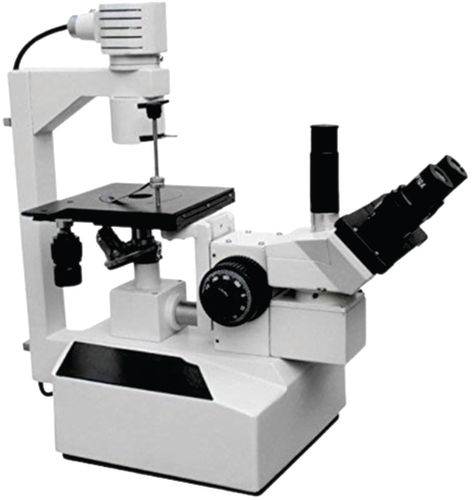
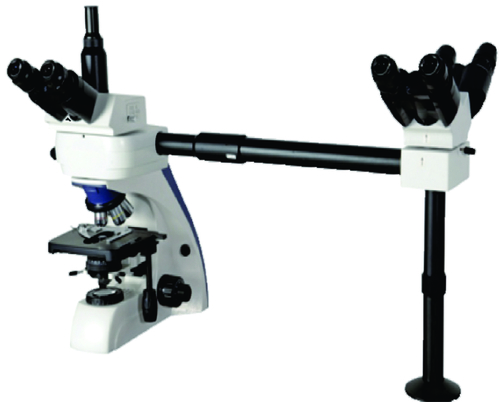
Research Grade Duel Head Microscope Face To Face About
45 Degree Inclined Dual Binocular Heads Adjusts to the DistanceBetween your Eyes 55 to 75mmInterpupillary Distance Diopter Adjustment on Both Oculars of EachScope Head to Correct for Your SpecicVision Needs Coaxial Fine and Coarse Focusing Knobs on BothSidesofMicroscopeCoarseAdjustmentTravelRange25mmStageMovementDistanceUpDownFineAdjustment Division 0002mm TensionAdjustable Coarse focusing Large Graduated Double Layer LowDriveCoaxialMechanicaltravelingonballguidesforsmoothmovementofslide125NAAbbesSubstageCondenserVariable6V20WHalogenTransmittedBaseIlluminationwithfollowingoptics
EyepieceWide Field 10x4x10x40x100xoil
Dual HeadTrinocular Microscope Model MVM2 FFtr Specication same as mentioned abovettedwithTrinocularobservationhead
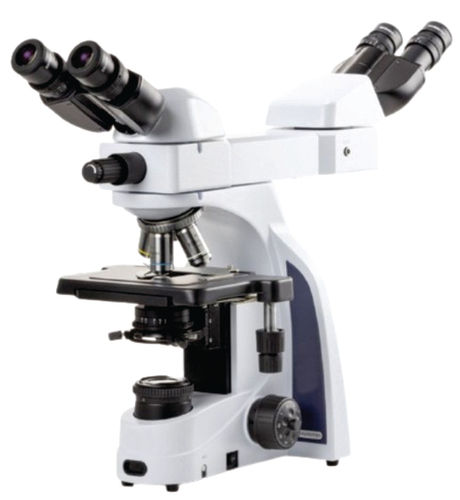
Enhanced Collaboration with Dual Head DesignThe face-to-face arrangement of the dual head allows two individuals to observe specimens simultaneously, fostering collaboration and shared learning in both educational and clinical environments. The 360 rotatable head and binocular tubes enhance comfort, making extended viewing sessions easy. This configuration is particularly suitable for instructors guiding students or for professionals discussing sample details in real time.
Precision Mechanics and Optical ExcellenceEquipped with X-Y dual axis mechanical stage movement, coarse and fine coaxial focusing, and vernier scales, this microscope ensures precise sample positioning and sharp imaging. Widefield 10X anti-fungal eyepieces and achromatic objectives offer a magnification range of 40X to 1000X, delivering high-resolution image clarity for various applications. Vibration-resistant construction supports consistent performance in demanding environments.
Flexible Illumination and Cordless OperationThe built-in LED lamp with variable intensity offers even illumination across samples, and the internal rechargeable battery permits cordless operation for up to several hours. This flexibility is practical for labs with limited power outlets or when relocating the microscope between rooms, making it easier to adapt to diverse teaching or research scenarios.
FAQ's of Research Grade Duel Head Microscope Face To Face:
Q: How does the dual head face-to-face configuration benefit teaching and collaborative work?
A: The face-to-face dual head design allows two users-such as a teacher and student, or two researchers-to view a specimen simultaneously, improving interactive discussion and immediate feedback on observations. This directly benefits environments focused on instruction, collaborative analysis, or training.
Q: What is the magnification range and how is it achieved with this microscope?
A: The microscope offers a total magnification range of 40X to 1000X, which is achieved by combining widefield 10X paired eyepieces with the supplied 4X, 10X, 40X (SL), and 100X (oil immersion) achromatic objectives. The high-quality optics ensure sharp, clear images at all magnifications.
Q: When should I use the built-in rechargeable battery, and how long does it last?
A: The internal rechargeable battery is intended for situations where a direct AC power source is unavailable or inconvenient, such as mobile lab setups or power outages. Once fully charged, the battery can provide several hours of cordless operation, depending on illumination settings.
Q: Where can this microscope be effectively utilized?
A: This research-grade dual head microscope is ideal for use in teaching laboratories, clinical diagnostics, and professional research settings-any environment requiring collaborative sample observation or instruction. Its heavy-duty build and dust protection make it suitable for long-term, frequent use.
Q: What is the process for focusing and moving specimens on this microscope?
A: Specimen slides are held securely with a spring-loaded clip on the mechanical stage, which features X-Y dual axis controls for easy positioning. Focusing involves both coarse and fine adjustment knobs, allowing for rapid movement and precise fine-tuning to ensure clear views at any magnification.
Q: How do the anti-reflection coated optics and vibration-resistant body enhance performance?
A: Anti-reflection coated optics reduce glare and increase contrast, resulting in clearer, high-quality images. The vibration-resistant die-cast metal frame ensures stability during observation, minimizing image distortion even under high magnification and frequent use.